

Words by Roxanne Robinson
Fixity is a fleeting concept in the digital age, where everything moves at the speed of light. David LaChapelle’s new show Vanishing Act at the VISU Contemporary gallery in Miami, presented by the gallery’s co-owner and co-curator Dr. Bruce Halpryn, explores this state of society that leaves attention spans to mere seconds. GRAZIA USA spoke to the photographer and artist from his Los Angeles studio, where he reflected on his own work and capturing today’s audience.
Highlighting the artist’s evolution are nine never-before-seen works. Will the World End in Fire, Will the World End in Ice (2025), a version of a previous piece, depicts cracking glaciers, a menacing sun, and a raucous Carnival cruise scene. Viewers may glean climate change, devil-may-care attitudes of the upper class, or even take the title literally. “The work chosen reflects this idea of a ‘vanishing act’, but I don’t attach meaning to it. I like when people interpret it themselves,” he said, adding, “Everyone who’s old enough feels we’re in a different time than ever before.”

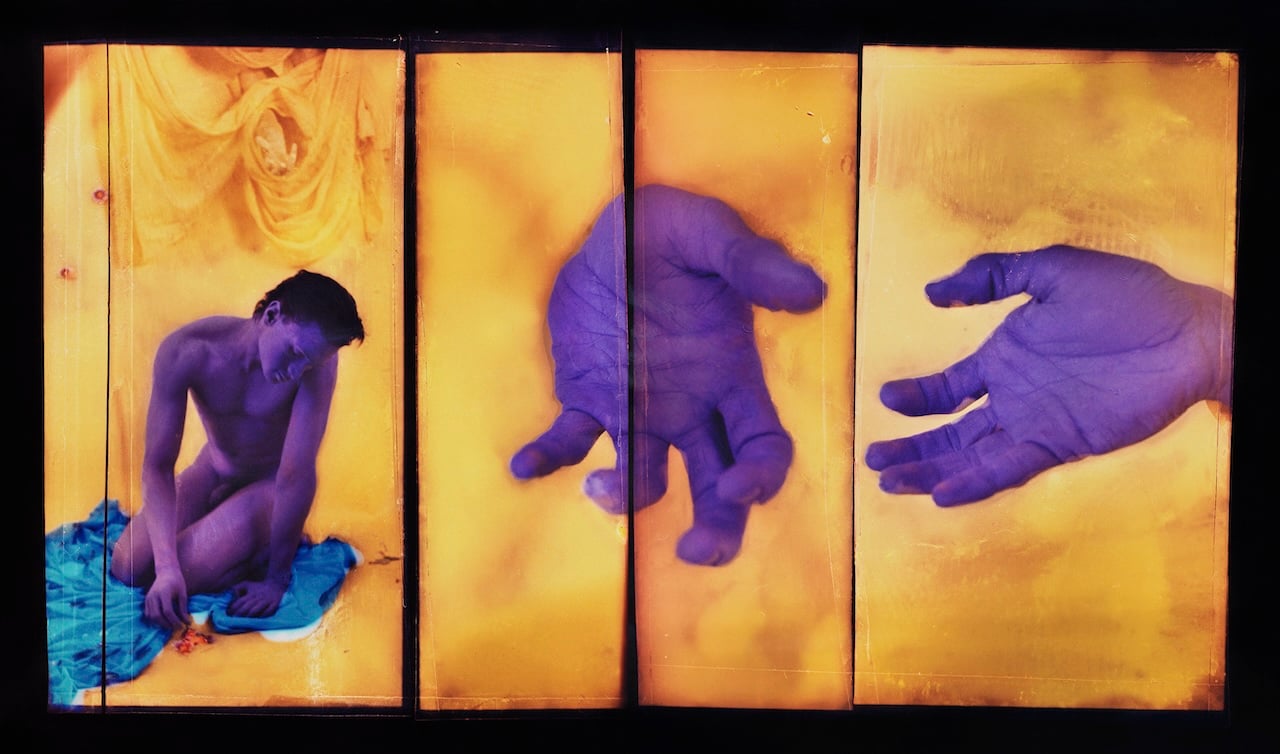
Negative Currency (1990-2025) is part of a series inspired by LaChapelle’s 1986 trip to Miami Beach for employer Andy Warhol at Interview magazine. He stayed at the Fontainebleau Hotel, which was full of rich Venezuelans. His Cuban friend noted that they felt superior to other Latinos because of their wealth. “The piece explores money being the root of all evil and how it’s not God we are trusting in, but materialism and technology,” the artist says. “Venezuela is now a failed country.”
The show features two groundbreaking angel photos that LaChapelle worked with the late feather master Martin Izquierdo—to whom he paid his last $2,000—to create custom white wings long before Angels in America or Victoria’s Secret. “As a kid in New York, AIDS felt apocalyptic but not for the entire world. It wasn’t like now, when things are at a precipice where anything could happen,” he said, adding, “It brought me deep into my faith. I wanted to illustrate that. My friends were dying. I figured I was positive and going to die, so I wanted to find a purpose. I keep my work beautiful and optimistic even when dealing with difficult topics like my fears or thoughts.”
According to Halpryn, “We live in transformative times; what’s bad is good, what’s good is bad. Without taking a political position, the show aims to reflect on those dynamics,” he said.
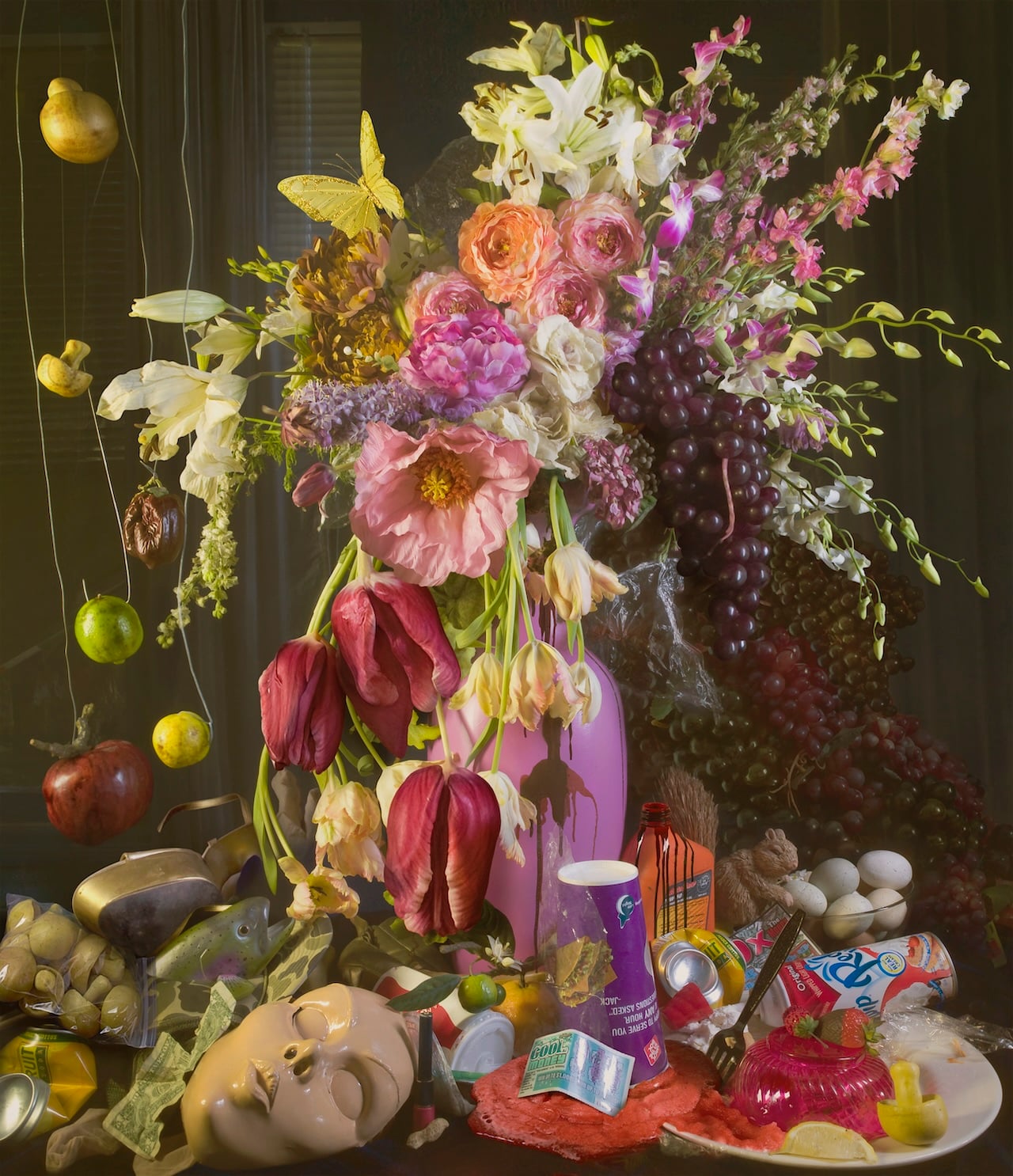
Five early glass-painted floral works are on offer to collectors for the first time. “The flowers are past their prime but still beautiful, hopefully not unlike people like me,” said the septuagenarian gallery owner. The gallery is the only U.S. contemporary fine art gallery authorized to carry and sell LaChapelle’s work.
LaChapelle compares the breadth of his work to a swimming pool. “In life, you don’t just want to swim on the shallow end or the deep end. You go back and forth. I’ve done pictures to make people laugh, for escape like fashion. It’s fun to look at. Then there is work with more depth and meaning,” he continued.
“Beauty, as a language, is a tool for capturing people’s attention.”
Halpryn aims to instill a view of both sides of the pool in the exhibition. “I hope viewers leave with a renewed sense of wonder—and perhaps a touch of unease. David’s work doesn’t offer easy answers; it invites contemplation about beauty, belief, and the fragility of everything we build. If visitors find themselves reflecting more deeply on what truly endures in their own lives, then the exhibition has done its job,” he said, noting that personally he would like to demonstrate that photography occupies the same emotional and intellectual space as painting or sculpture. “It can move, challenge, and transform us.”
There is another Florida exhibition of LaChapelle’s work upcoming, including a retrospective at the Orlando Museum of Art, the show he says draws a lot of young audience interest: “Photographing pop stars brings in the kids, and they discover works they didn’t know about.”
Capturing Gen Z screen-free is the photographer’s secret power. “Attention spans have gotten shorter; we’re in a different time. Beauty, as a language, is a tool for capturing people’s attention. They look at beautiful things longer.”
The show runs November 29, 2025, through January 31, 2026, with a free public grand opening with David LaChapelle on December 5.
This story first appeared on GRAZIA USA.
READ MORE
Land As Memory: The Palestinian Artists Reclaiming Landscape Through Art
YTL Cement Group’s Penyu Shell-Ter Project Bridges Art and Turtle Conservation
The Light That Denica Riadini-Flesch Weaves with SukkhaCitta