

In 2020, YSL Beauty launched Abuse Is Not Love in response to a global reality that remains both pervasive and under-acknowledged: 1 in 3 women will experience violence by a partner in her lifetime, yet only a small fraction of survivors ever obtain justice. The initiative was created to help prevent and combat intimate partner violence by addressing the early warning signs that are often overlooked — or misunderstood — in abusive relationships.
For its latest thought-leadership report, the brand partnered with psychologist and author Dr. Sara Kuburic to shift the conversation inward, examining how abuse is frequently felt long before it is named. Drawing on insights from survivors and non-profit organizations working across 8 countries, the research centers on the internal experiences that can signal danger even when external proof feels unclear.
Since launching Abuse Is Not Love, YSL Beauty has trained more than 1.3 million people to recognize the warning signs of abuse and has committed to educating 2 million people worldwide by 2030. That commitment spans partnerships with non-profit organizations, employee training programs, and the funding of open-access academic research — an effort to ensure awareness, education, and resources move in tandem.
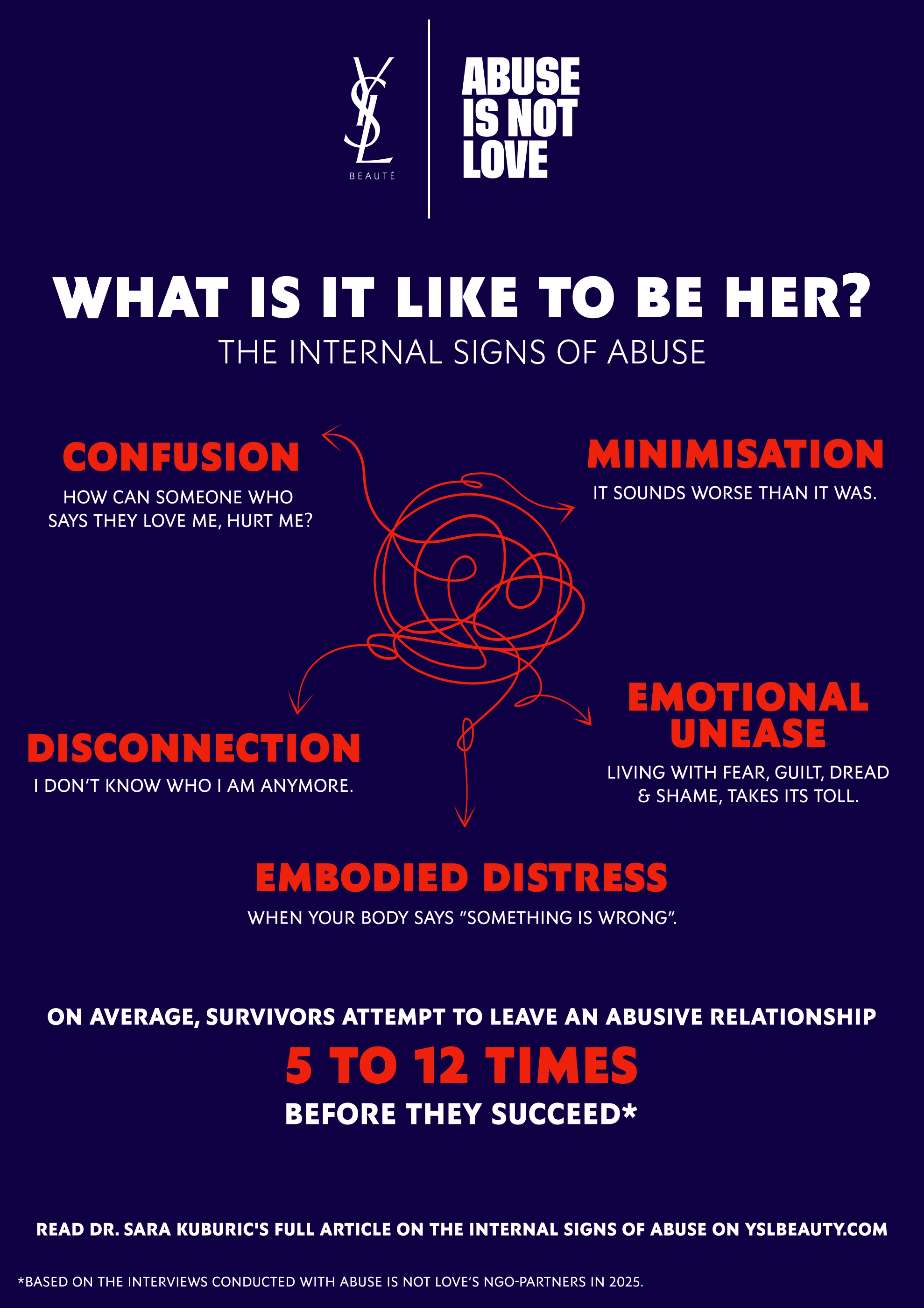
Across cultures and communities, 5 internal warning signs emerged consistently: confusion, minimization, emotional unease, disconnection from self and others, and embodied distress. Together, they offer a framework for understanding what abuse can feel like from the inside — and why leaving is rarely simple or immediate.
Below, Dr. Kuburic explains why these internal signals matter, how they manifest in real time, and what she hopes readers begin to recognize in themselves and others.
GRAZIA: What prompted you to focus specifically on the internal warning signs of abuse for this year’s report?
DR. SARA KUBURIC: As a society, we tend to observe or talk about survivors in a very detached way. I often hear people speculating about what they think is happening, what the survivor should or shouldn’t do, or whose “fault” it might be. Much of this discourse comes from a place of judgment, fear, or misunderstanding. I felt it was time to shift the focus in our conversations from talking about her, to exploring what it’s like to be her — an approach rooted in mindfulness and compassion.
The 5 internal signs of abuse are meant to offer an additional layer of protection and awareness. When you’re in an unhealthy relationship, it can be overwhelming and difficult to evaluate your partner’s behavior or to know what is “normal.” Turning inward can offer critical clues that something is not right. My hope is that recognizing these inner signs helps people trust themselves and seek support or leave unsafe situations sooner.
GRAZIA: In your research across multiple countries, what patterns or themes appeared most consistently among survivors?
DR. KUBURIC: The patterns and themes were noted as the 5 internal signs in the article: confusion, minimization, disconnection (with self and others), emotional unease, and embodied distress. I had the honor of interviewing YSL Beauty’s NGO partners across 8 countries: the United States, Germany, Indonesia, South Africa, Portugal, Bulgaria, Croatia, and Spain. These organizations work closely with survivors and bring decades of expertise to this issue. The phrases, emotions, and reflections shared by survivors through these partners became the heartbeat of this piece. Their lived experiences helped guide the language and themes, ensuring that the work remained grounded in their reality.
GRAZIA: Why is confusion often the first internal sign — and why is it so misunderstood?
DR. KUBURIC: Confusion is a significant but often overlooked sign; I go as far as to call abuse a pandemic of confusion. This is because it scrambles our inner compass until we no longer know what is normal, who we are, or what to do. Survivors often live in a haze, trying to reconcile their partner’s words with their actions, or the person they believed their partner to be with the reality they’re experiencing. They also struggle to understand how someone they love could harm them or how they themselves could be “someone this happens to.”
It’s like trying to drive through dense fog: when clarity is lost, it’s hard to know which direction to go. Abuse creates that fog, making decisions feel impossible and scary.
Confusion is also deeply misunderstood because, from the outside, abuse can look very linear. People imagine obvious red flags, clear turning points, or dramatic moments of recognition. In reality, most survivors describe the opposite. Abuse is gradual, alternating between harm and tenderness, criticism and affection. That inconsistency keeps people doubting their own perception. It’s not that survivors miss the signs. It’s that the signs contradict each other.
GRAZIA: How can people differentiate minimization from normal relationship conflict?
DR. KUBURIC: In healthy relationships, conflict is about 2 people trying to understand each other and work together as a team to solve a problem. Even when it’s uncomfortable, it usually leads to repair or clarity.
Minimization is different. It’s what happens when we downplay or dismiss behaviors that, deep down, we know are not okay. We do it because admitting the truth feels too painful, too frightening, or too disruptive to the relationship we hoped we were in. Minimization isn’t about resolving a disagreement. It’s about protecting ourselves from the reality of harm. You can hear it in the little stories we tell ourselves: “It’s not that bad.” “Everyone fights.” “I’m being dramatic.” Over time, this self-silencing becomes a survival strategy.
The distinction is simple but profound. Normal conflict makes space for 2 truths; minimization erases your own. If you consistently shrink your feelings to preserve the relationship, it’s a warning sign.
GRAZIA: What does “disconnection from self” look like in real time for someone experiencing abuse?
DR. KUBURIC: In real time, it can look like watching yourself from a distance. You might agree to things you don’t want, ignore needs you once honored, or rationalize behavior you know would have once felt like a big deal. Many survivors describe a sense of fading. They stop recognizing their own preferences, boundaries, and emotions. It’s not that they lose themselves all at once. It’s that they drift away piece by piece. For many, being themselves starts to feel progressively less safe.
GRAZIA: Emotional unease can be subtle — what emotional shifts should people pay attention to?
DR. KUBURIC: You might notice a heaviness before seeing your partner, a knot in your stomach after certain conversations, or a growing sense of relief when they’re not around. You may catch yourself walking on eggshells, rehearsing what you’re going to say, or bracing for reactions. Another early shift is shame: feeling embarrassed to tell friends what’s happening or hiding parts of the relationship you once shared openly. When your emotional landscape starts feeling smaller, tenser, or harder to inhabit, it’s worth paying attention. Our emotions are important messengers of danger.
GRAZIA: Why is the body often the earliest place that abuse manifests?
DR. KUBURIC: The body holds what the mind tries to rationalize. Long before we can name what’s happening, our nervous system registers patterns of unpredictability, fear, or threat. Survivors often describe headaches, chest tightness, nausea, insomnia, or chronic exhaustion well before they consciously recognize the relationship as unsafe. This happens because the body is not interested in narratives; it’s interested in survival. When something feels dangerous, even subtly, our physiology responds. The body flags what our brain is still hoping isn’t true. That’s why somatic clues can be such powerful early warning signs.
GRAZIA: What do you think is the biggest misconception about why survivors stay, and why leaving takes multiple attempts?
DR. KUBURIC: The biggest misconception is that survivors stay because they are “weak.” In reality, they are powerhouses navigating layers of fear, love, hope, financial dependence, trauma bonding, isolation, and threats of escalating harm. Abuse is designed to make leaving feel impossible and trick the survivor into staying. It’s no surprise that leaving often requires multiple attempts; survivors are not indecisive, they’re surviving.
GRAZIA: How do cultural expectations — family, romance narratives, holiday pressures — reinforce these internal warning signs?
DR. KUBURIC: Cultural narratives can become accomplices to our silence. Many of us grow up absorbing stories that normalize suffering in the name of love, celebrate endurance over wellbeing, or equate loyalty with self-betrayal. Family expectations can add another layer, urging people to “keep the peace,” “try harder,” or “not give up.”
These societal pressures don’t create abuse, but they can deepen confusion, minimization, and self-blame. They make it harder for survivors to trust their own discomfort and easier to justify staying in harmful dynamics. Naming these pressures helps loosen their grip and reminds survivors that their pain is not a personal failure — it’s a human response to being harmed.
GRAZIA: What do you hope people reading this report begin to understand about abuse that they may not have before?
DR. KUBURIC: I hope it deepens public awareness of what intimate partner violence can feel like from the inside and encourages women to trust their intuition when something doesn’t feel right. Often, when something feels off, it probably is.
My goal is to help individuals recognize these signs earlier and feel empowered to seek support. On a broader level, I hope it challenges the narratives that romanticize suffering and instead contribute to a culture that values emotional safety as much as romantic love — a world where “love” and “harm” are no longer confused.
GRAZIA: How do you see your work with YSL Beauty amplifying the conversation beyond traditional mental-health spaces?
DR. KUBURIC: So many young women look up to brands like YSL Beauty as aspirational, and with that kind of influence comes profound responsibility. I was deeply moved to see YSL Beauty embrace that responsibility in such a tangible and meaningful way. From Saint Laurent himself, who empowered women through his bold designs and challenged gender norms, individual empowerment and independence have always been part of the brand’s DNA. That legacy makes its stance against violence even more powerful.
By shining a light on the often-invisible realities of abuse, they’re helping dismantle stigma and giving countless survivors the courage to name their experiences. This kind of visibility can be life-changing, even lifesaving.
This story first appeared on GRAZIA USA.
READ MORE