In a sea of mainstream music, one person is going against the current with her haunting dark pop genre, building worlds and languages through story before the music even comes through—and her name is Tengku Hadhira. She immediately stands out wherever she goes, with her flaming red hair and the traditional outfits she dons, whether on stage or in her everyday life. “There’s something about it that brings me comfort. For so long I had been so Westernised, but after releasing my original songs, I started wearing more baju kurung and kebaya, and I felt like I was in my own skin finally,” she told us, all bubbly. That’s another thing you notice about Tengku Hadhira—her bubbly personality and how she gets excited talking about her love of writing horror stories, even though a big reason for it stemmed from childhood trauma. “Abuse gave me a lot of inspiration, actually,” she said candidly. As a descendant of royalty, her family had a history of mysticism, and “elements of spiritual illnesses that spread throughout the family,” she explained. That was how it shaped her artistic direction.
How does one go from writing horror stories to singing about them? “The more I ventured into my dark arts direction, the more world-building and stories that I wrote from way back then till today meshed together to get what I have now,” she said. Her creative process is an unusual one, beginning with her writing the stories first, and then only the songs. “The stories are formed first, and then the music comes out from it,” she said giddily.
She went on explaining that the projects that she has worked on have never been based simply on trying to make them beautiful or dark. What she writes about, at its core, are women’s pains. “Every time we survive a traumatic incident, we lose a lot of ourselves,” she said earnestly. “We don’t know how to feel the same way, and our bodies do not know how to respond to these new feelings.”
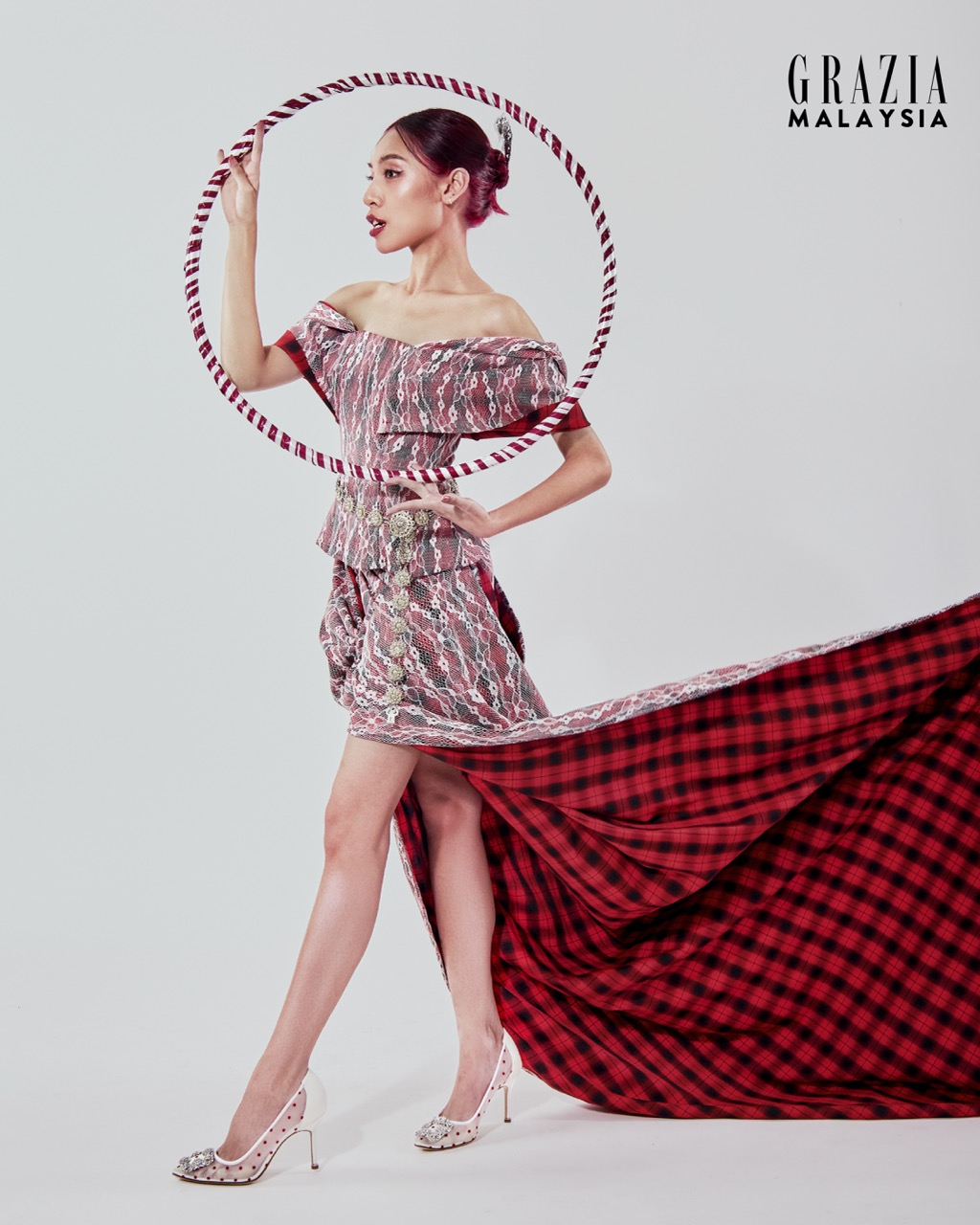
MANOLO BLAHNIK, Shoes
Women, she said, carry a lot of darkness within them—repressed rage. For generations, we were taught to filter our voices and feelings, to put on a smile when we’re outside, despite whatever traumatic things we endured just the night before. Society would always judge us if we showed any trace of feelings. “I wanted to highlight that in my projects,” Tengku Hadhira said. “We don’t have to hide it. We can be victims. If we keep it inside, we may become evil. We will never truly know how we feel because we have to fit in out of survival.”
“I suppose at the core of my music, it’s really about dark feminism. It’s the real truth of women instead of blind women’s empowerment. I think it’s a little shallow when we put that label on us. We went through so much more; why are we not talking about our darkness?” she continued.
This year, she released Saori no Ningyo, a multifaceted production comprising original music along with a play, which she credits to be her biggest achievement thus far, alongside a horror, batik maze conceptual show that sold out for two days straight. “I’ve never had a victory like that in my life before,” she gushed. People typically don’t buy into her conceptual projects, she said, as the local creative scene is more supportive of palatable art concepts—not so much experimental pieces like what she normally puts out.
In 2026 though, she’s anticipating something bigger—something she’s already working on. Khorrossit is based on a story she wrote before about covenants from all around the world. The witch factions would have a duel with each other based on their spells. “I’m also creating an original djinn language with my friend who has a Master’s in Linguistics,” she shared. “It’s a whole thing! I hope to be able to release it in April of next year.”
Photography: Sarah Hobbs
Styling & Creative Direction: Joseph Cheng
Art Direction: Nadia Aswardy
Hair: VV Chan, Zac Lee, Philex Chin, Cody Chua
Makeup: Eranthe Loo, Crystal Fong (Plika Makeup)
Styling Assistants: Sarah Chong, Lorraine Chai, Maryssa Helmi
Photography Assistants: Ayiesha Almas, Brandan Simon
READ MORE