
Gird your loins, because it’s not a great time to be a progressive woman. Despite being better educated, more active in the labour market and more visible in leadership positions than ever before, according to the World Inequality Report, gender inequality remains a defining feature of the global economy.
Women account for 49.7% of the population, yet only 29% of c-suite positions and 10-15% of CEO roles globally. According to the UN, at the current rate, gender equality in the highest positions of power in governments around the world will not be reached for another 130 years. Meanwhile social media is awash with #manosphere and #tradwife content desperate to tell us that women’s lives would not only be easier, but better if we just stayed at home. Something that isn’t helped by the fact 52% of mothers face discrimination during pregnancy, maternity leave or upon return to work and one in five are forced to leave their jobs after becoming parents.
Re-enter Miranda Priestly – the formidable, flawed fashion magazine mogul and mother-of-two gracing our screens after 20 years in the Devil Wears Prada sequel, Devil Wears Prada 2. Allegedly inspired by Anna Wintour, the former editor-in-chief of Vogue who now serves as Condé Nast’s global chief content officer and Vogue’s global editorial director, Priestly is not entirely a work of fiction. She is a cultural manifestation of female ambition and all that it entails.
When the first film aired in 2006, Priestly, played by the incomparable Meryl Streep, was maligned for her workaholism, her outlandish requests to her assistants and her signature steely disposition which could destroy careers with the purse of a lip. However, Streep and her iconic side-swept bob made sure to depict Priestly not as a caricature, but as a feminine virtuoso – and, crucially, as a human being.
One scene that lifts the veil in the first film is when Priestly, bare faced in a dressing gown in her Paris hotel room, asks her assistant Andy Sachs (Anne Hathaway) to review the seating plan for Runway’s Fashion Week luncheon. She explains that her husband Stephen, who she was seen arguing with earlier in the film, will no longer be joining them because he’s decided to file for divorce. It’s exposition at its finest, adding layers to her personal life without betraying the central tension: that she loves to work.
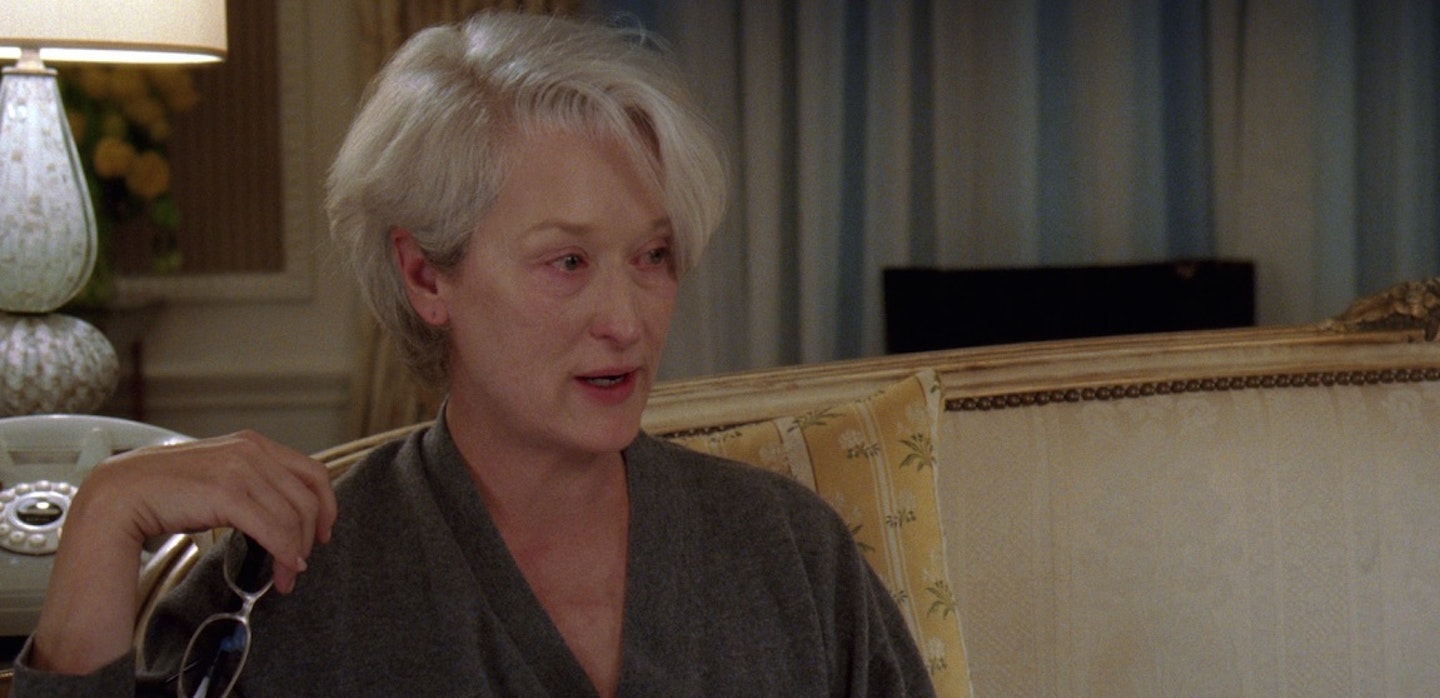
Streep fought for that scene to make the final cut. ‘I also wanted a scene where she is without her armour,’ the actress explained. ‘The unpeeled scene in the hotel room – just to see that face without [its] protective glaze, to glimpse the woman in the businesswoman.’ The three-time Oscar winner also adjusted Priestly’s final line in the first film, when Sachs is accusing her of betraying Nigel (Stanley Tucci) to save her position at the magazine, from ‘Everybody wants to be me’ to ‘Everybody wants to be us’. In doing so, she transformed herself from an anomalous villain into someone women could project their ambitions onto without shame. The truth being that, just like millions of men before them, plenty of women want to prioritise their careers.
Enough time has passed since then for society to have embraced and subsequently rejected #GirlBoss feminism, which supports the idea that Priestly’s success alone is enough for all women to celebrate, but we seem to have arrived at a crossroads. There are still millions of women who want to work, and who want to thrive at work, whether they also have children or not. Admitting that, both in a practical sense and in terms of where the current regressive discourse is headed, feels like swimming against the tide.
Without giving too much away, there is a moment in Devil Wears Prada 2 that mirrors that final scene – and feels even more relevant today. As Priestly and Sachs are sat in the back of a cab in Milan, Priestly reveals that she knows Sachs has been in talks to write a biography about her. ‘Write the book,’ she says, telling her not leave out the headlines, the divorces, the lost time with her children. ‘I love to work, but people should know it comes at a cost.’
As bleak as it may sound, it is incredibly refreshing to hear a powerful female character speak candidly about loving what she does – regardless of the personal sacrifice. It is this exact same sacrifice that has allowed men to thrive in positions of power since the dawn of time, and they are never judged, pitied or ridiculed for it.
There is enough exposition across the two films to show that Priestly cares about her family and her personal relationships, but she is equally proud of the fact she is at the helm of a cultural institution and has been for decades.
We’re not supposed to think she ‘has it all’ or that her twins aren’t in extensive therapy, and we’re also not necessarily supposed to aspire to be her, but Priestly’s career is of paramount importance to her. She loves work – and that’s nothing to be ashamed of.
She might be called a ‘dragon lady’ for it, as she would be in real life, but this character does not aspire towards a ‘soft life’. She doesn’t want to make bubble gum from scratch in a gingham shift dress. She doesn’t centre men. She doesn’t care more about her children’s school assembly than she does an important meeting at work. She knows all the things she’s had to give up, but she still wants to do her job anyway.
Her original protégé Emily Charlton (Emily Blunt) is much the same, ruthlessly ambitious (and still iconic), who at one point calls out her ex-husband over FaceTime for not knowing how to look after their children on his own. As is Sachs, who left Runway and became an award-winning, boots on the ground features writer. Driven, successful and happy, she also happens to be single and child-free.
These versions of womanhood are not for everyone, but they should be available for women just as they are for men. Until we start calling male editors-in chief and CEOs ‘workaholics’ who are missing out on bed and bath time, or ‘tragic’ for choosing their career over having children, we should stop doing the same to women. After all, if we’re 130 years off schedule for gender equality, we haven’t got time to waste.
This story first appeared on GRAZIA UK.
READ MORE